
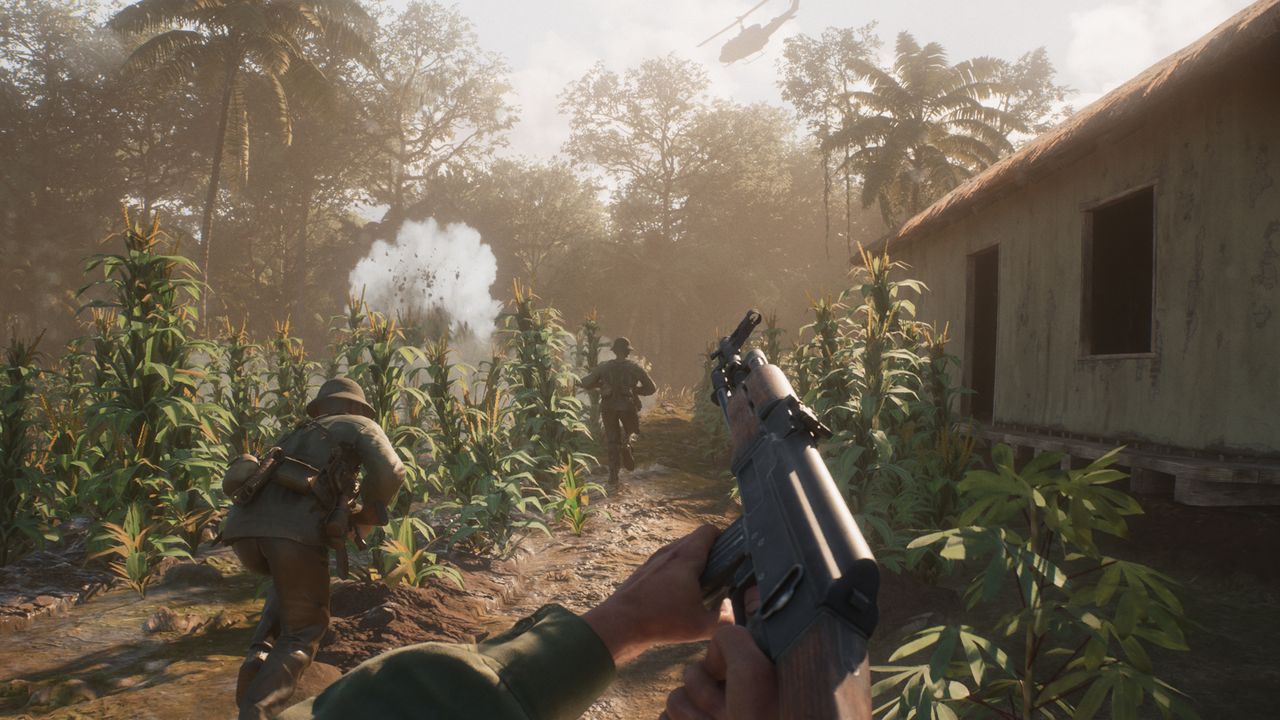
Nothing humbles a fan of first-person shooters faster than a hardcore military simulation like Hell Let Loose: Vietnam. Picture the scene: you’re creeping under the dense cover of the jungle canopy as helicopters whir overhead, their rotors cutting through the humid air. Short, sharp bursts of gunfire serve as your only real guide toward a forming frontline, while squad orders crackle over the communications line as a Commander scrambles infantry units back through the brush to reform fracturing formations. As enemies pour over the crest of a distant hill, your M16 rumbles and bodies crumble before you. And then, nothing. A bullet fired from an unknown location rips through your torso. Medics in the area ignore your desperate pleas for help. The long, humbling walk back to the action begins again.
This visceral experience represents the core philosophy of Hell Let Loose: Vietnam, the latest entry in the acclaimed military simulation franchise developed by Expression Games and published by Team17. The game transports players to one of the most controversial and impactful conflicts of the 20th century, offering an unflinching portrayal of the Vietnam War that prioritizes realism over accessibility. Unlike mainstream shooters that reward individual heroics and fast-paced action, this title demands patience, communication, and an acceptance that death can come swiftly and without warning from enemies you never see.
The Evolution of Military Simulation Gaming
The military simulation genre has a rich history dating back to the early days of PC gaming. Titles like Operation Flashpoint, released in 2001, established the blueprint for realistic combat experiences that prioritized tactical thinking over twitch reflexes. The ARMA series continued this legacy, cultivating a dedicated community of players who appreciated the genre’s uncompromising approach to warfare simulation. Hell Let Loose: Vietnam builds upon this foundation while setting itself apart through its specific historical focus and refined gameplay mechanics that balance authenticity with playability.
For many players, military simulations represent a graduation from more accessible titles like Battlefield, Ghost Recon, and SOCOM. These mainstream franchises offer engaging combat experiences but ultimately follow predictable gameplay cycles designed to maximize entertainment value. Military simulations like Hell Let Loose: Vietnam deliberately subvert these expectations, creating friction and frustration as core design elements rather than bugs to be eliminated. The result is an experience that feels genuinely tense and consequential, where every decision carries weight and every death teaches a lesson.
Dynamic Frontlines and Team-Based Warfare
Hell Let Loose: Vietnam populates its exceptionally wide multiplayer arenas with 100 players, creating a scale of combat that few other games attempt to match. The experience is defined by dynamic frontlines that shift and evolve based on the collective actions of both teams. Intense communication becomes not just helpful but absolutely essential, as every soldier has a specific role to play within the larger tactical framework. Players must buy into the fantasy of their assigned Command, Support, Infantry, or Specialized unit for the unforgiving shooter to function appropriately.
The respawn system exemplifies how Hell Let Loose: Vietnam puts theory into practice in ways that challenge conventional gaming expectations. Unlike most modern shooters, players cannot spawn directly on their squadmates. Instead, redeployment occurs from Garrisons, which must be created through coordination between Commanders and Specialists, or from Outposts placed by Squad Leaders near objective points. If these critical spawn points fail to be established, players face the grim prospect of respawning at headquarters, potentially facing a ten-minute walk back to any meaningful action. This design choice reinforces the importance of teamwork and strategic thinking over individual performance.
Gameplay Philosophy and Design Decisions
With these mechanics in mind, setting up Outposts or fortifying capture points to enable faster redeployments becomes just as valuable—if not more so—than generating impressive kill counts and assists. Hell Let Loose: Vietnam reflects this philosophy through its unstable firing models, minimal weapon feedback, and limited visual hit detection. The objective is to win the day as a cohesive unit, not to dominate the leaderboard as an individual player. Eliminating enemy soldiers serves as a means to territorial and strategic ends rather than a primary goal in itself.
When everything clicks and 50 players come together to generate genuine battlefield momentum, the experience becomes fairly spectacular. The combat feels intense and rapid, capturing a tangible sense of large-scale warfare that mainstream titles like Battlefield can only dream of delivering. However, when a round fails to come together, the experience can devolve into a frustrating slog through open expanses. Players may find themselves lamenting the shifting nature of online gaming culture, where widespread microphone adoption—at least on console platforms—seems like a relic of a distant past. This presents a significant challenge for a multiplayer game fundamentally built around quick-fire collaboration and constant communication.
A Distinct Identity in a Crowded Market
Hell Let Loose: Vietnam emerges as a polished first-person shooter with a well-defined identity that clearly separates it from Battlefield, Call of Duty, and the waves of battle royale and extraction shooters currently dominating sales charts. It presents a challenging, uncompromising experience that simply won’t appeal to everyone. The brutality isn’t a bug—it’s a feature, serving as the great differentiator that gives developer Expression Games a unique lane to dominate within the competitive shooter marketplace.
The Vietnam War setting adds historical significance and emotional weight to the proceedings. The conflict, which lasted from 1955 to 1975, remains one of the most studied and debated military engagements in modern history. Games set during this period carry unique responsibilities regarding authenticity and respect for those who served. Expression Games appears to have approached this challenge thoughtfully, creating an experience that honors the tactical realities of jungle warfare while delivering engaging gameplay for modern audiences. Hell Let Loose: Vietnam is scheduled for release on PC, PlayStation 5, and Xbox Series X on August 13, 2025, offering players a chance to experience military simulation gaming at its most demanding and rewarding.
Expert Opinion: Hell Let Loose: Vietnam represents a significant moment for the military simulation genre, potentially introducing hardcore tactical gameplay to a broader console audience. The game’s August release positions it strategically before the fall gaming rush, giving it room to build a dedicated community. Success will largely depend on whether the player base embraces the communication-heavy gameplay—if sufficient players invest in microphones and teamwork, this could become the defining mil-sim experience of the generation.