New Zealand-based games agency Gyld has successfully raised $1 million in funding to accelerate the rollout of its proprietary games research system, Critical Compass. The oversubscribed round was led by Kameha Ventures, with participation from notable industry angel investors including representatives from mod.io, indie.bi, and ICO Partners. The company, best known for representing Sandfall Interactive’s critically acclaimed Clair Obscur: Expedition 33, plans to use the capital to make its data-driven research tools available to a broader range of game developers, publishers, and investors navigating an increasingly challenging market landscape.
The funding announcement comes at a particularly turbulent time for the video game industry, which has experienced its most severe correction in decades. Mass layoffs have swept through major studios, with companies like Microsoft, Sony, and Electronic Arts cutting thousands of positions since 2023. Independent developers face mounting pressure to secure funding and publishing deals, while investors have become increasingly cautious about backing new projects. Against this backdrop, Gyld’s Critical Compass system promises to bring rigorous, data-driven analysis to an industry that has historically relied on intuition and genre-based categorizations for market research.
From Internal Tool to Industry Solution
Critical Compass was originally developed in 2020 as Gyld’s internal evaluation system for assessing which game projects to support with its own capital. Over the past five years, the platform has quietly been utilized by major industry players including Sega, Gameloft, and Amplitude Studios. The system has supported more than $100 million in funding and publishing outcomes across over 45 different projects, demonstrating its practical application in real-world business decisions. Gyld reports a remarkable track record, claiming a 100% success rate in predicting failure for projects deemed commercially unviable — with every project that proceeded without addressing the system’s recommendations either failing to secure publishing deals or launching to poor commercial reception.
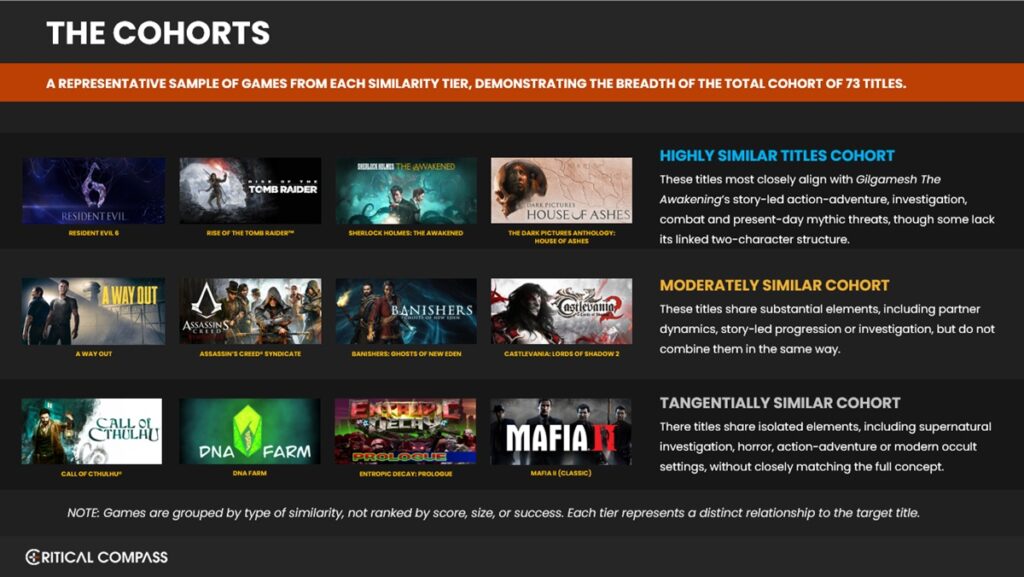
The platform’s architecture is built upon a library of more than 200 different analytical pipelines, each representing research-based and scientifically validated models. These range from straightforward pricing optimization tools to complex systems for codifying games beyond traditional genre classifications. Unlike conventional market research that categorizes titles into broad genres like RPG, Action, or Shooter, Critical Compass creates detailed DNA profiles of each game, examining nuanced archetypes, audience behaviors, and historically relevant patterns. This granular approach enables the system to identify predictable risks and opportunities that broader analyses might miss entirely.
AI-Powered Analysis with Human Accountability
At the core of Critical Compass is a sophisticated blend of artificial intelligence and human expertise. Specialist AI agents investigate market conditions, storefront data, community sentiment, and competitive landscapes within frameworks developed by Gyld’s data scientists. However, the company emphasizes that human analysts remain accountable for every recommendation, interrogating the AI-generated findings before delivering final assessments. Importantly, Gyld distinguishes its platform from generative AI tools that have sparked controversy in the gaming industry — Critical Compass is explicitly designed for decision support rather than content generation, producing no game art, code, writing, or other creative assets.
CEO Emre Deniz addressed the shortcomings of existing market research in the games industry, stating that the sector has never lacked market research but has lacked research worth paying for. He emphasized that Gyld built Critical Compass with its own money at risk, sharing risks with developers, which creates accountability for the accuracy of its recommendations. Co-founder Lex Suurland highlighted the specific nature of the questions the platform addresses: identifying genuine competitors, optimal launch timing, appropriate pricing, and whether investment theses are actually supported by player behavior. These are specific decisions about specific games that deserve specific evidence rather than generic answers applied uniformly across entire genres.
Proven Track Record and Industry Impact
The platform’s effectiveness was demonstrated early in its development when an initial version informed Gyld’s decision to represent Sandfall Interactive’s prototype of Clair Obscur: Expedition 33. That title has since become one of the most anticipated releases in the turn-based RPG space, validating the system’s ability to identify promising projects at early stages. Studios working with Gyld have collectively added 84 new hires following Critical Compass-supported outcomes, suggesting that successful funding and publishing decisions have translated into tangible growth for development teams. The company will showcase Critical Compass at Gamescom in Germany, where developers, publishers, investors, and platform holders can commission reports and bespoke research engagements. Notably, Critical Compass will remain an internal Gyld research system rather than self-service software, ensuring that human expertise remains central to its application in an industry desperately seeking reliable guidance through uncertain times.
Expert Opinion: The games industry’s current volatility makes data-driven decision tools increasingly valuable, and Gyld’s approach of combining AI analysis with human accountability addresses growing concerns about over-reliance on automated systems. If Critical Compass maintains its claimed accuracy rates at scale, it could fundamentally shift how publishers evaluate risk and allocate resources, potentially reducing the industry’s historically high failure rate for new titles while giving smaller studios a competitive edge in securing funding.